

One of the most common questions I hear is: “How do I actually learn and remember new words?” And it makes sense — learning a language as an adult means you’re learning how to express the entire world in new ways, with unfamiliar structures and sounds.
It’s challenging, but also completely possible with the right strategies.
Here are four simple ways to learn and remember new words 👇🏼
Speak Aloud
Speaking aloud is incredibly important.
It’s one thing to recognize a word when reading — it’s another to confidently say it out loud.
Often, we can recall words passively on the page, but when it’s time to use them in conversation, there’s hesitation. Was it exactly like that, or am I mixing it up with another word?
Speaking words aloud bridges the gap between passive recognition and active use.
When you say words out loud, you’re engaging multiple parts of the brain. The motor skills involved in speaking activate the brain’s memory pathways, while hearing yourself adds an extra layer of sensory reinforcement.
This process strengthens recall (remembering) and helps you become more comfortable using the words naturally in conversation.
So, when you learn new words, don’t just read them — say them.
Helen Keller, who was deaf and blind, once wrote about learning to speak:
“I was forced to repeat the words or sentences, sometimes for hours, until I felt the proper ring in my own voice. My work was practice, practice, practice. Discouragement and weariness cast me down frequently; but the next moment, the thought that I should soon be at home and show my loved ones what I had accomplished spurred me on.
I had made my homeward journey, talking constantly to Miss Sullivan, not for the sake of talking, but determined to improve to the last minute.”
Her story reminds us that repetition, persistence, and speaking aloud help us make progress, even when it feels tough. Keep going — every word you say out loud helps you get better and more able to connect with your loved ones at a deeper level.
Learn words as combos
Another powerful way to absorb vocabulary is to learn words in combos — groups of words that naturally go together.
In my 30-Day Brazilian Portuguese Challenge, I include exercises where you practice with word combinations, like fazer uma cirurgia (to have surgery) or sofrer um acidente (to have an accident). Notice how the verbs differ between English and Portuguese in these combos? Practicing the words together helps you remember the correct verb for each expression.
Here’s an example from the course:

Why is this so effective?
Because the brain is wired to recognize patterns. When you practice words as combos, words commonly used together get stored as a unit, making recall faster and more natural.
This approach helps you remember words not in isolation but as part of meaningful phrases you’re likely to hear and use.
When practicing vocabulary, focus on these natural combinations rather than single words. You’ll speak more fluently and avoid the mental pause of searching for the “right” word in the moment.
Use Words in Context
Another important way to make vocabulary stick is to use words in context.
What do I mean by that?
In my 30-Day Brazilian Portuguese Challenge course, I include exercises where you drag words or fill in the blanks to complete sentences within a full paragraph, seeing them in action and in context.
Here’s an example:
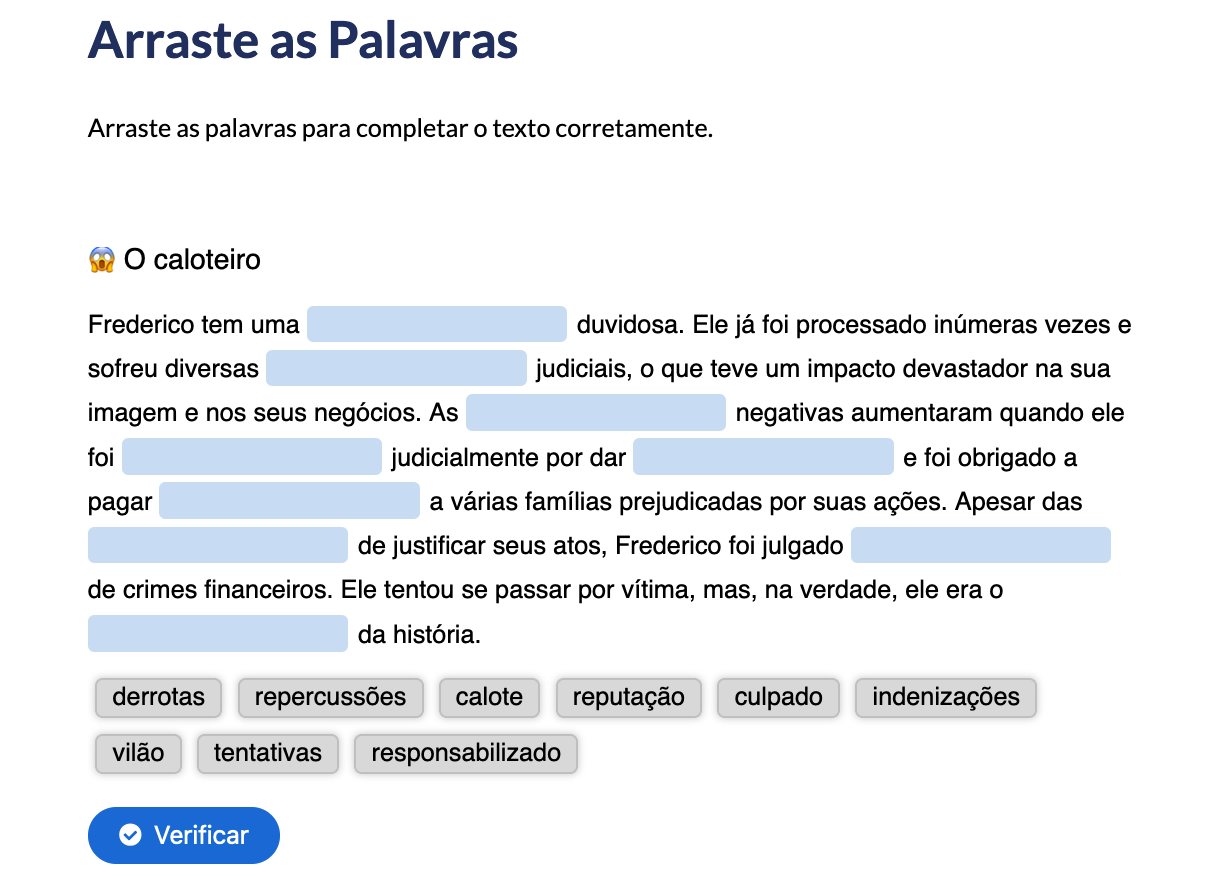
This approach lets you experience how the words naturally fit into real-life situations, making it easier to recall and use them in your own conversations.
You can apply this strategy on your own too!
Think of people you know, situations from your daily life, or events happening around you. Create sentences and paragraphs using the new words in those familiar contexts.
For example, if you’re learning words about family, write sentences describing your relatives or something that recently happened at home.
If you’ve learned words about travel, create sentences about your last trip or an upcoming vacation.
By placing vocabulary into real scenarios, you help your brain build stronger connections—because words make more sense when they feel relevant to your life.
Use the Words in Conversation
Finally, this is incredibly important for learning new words: use them in real conversations.
Even when a word translates easily into your native language, it doesn’t always carry the same meaning or work in the same contexts.
I’ll never forget one of my first weekends with Carl, who’s now my husband. Early in our relationship, we had an amazing weekend together, and at the end, he said it had been a decadent weekend.
I was confused 🤔 because for me, decadent (decadente, in Portuguese) meant something negative, like something in decline. I didn’t realize that in English, it often describes something indulgent, luxurious, and positive. We still laugh about that mix-up to this day. 🤣
That’s why it’s so important to test words in real-life situations.
Try using new words in conversations with people you feel comfortable with — explore, see if they fit the way you expect.
Mistakes are part of the process, and sometimes, like in my story, they help clarify meanings in a way that sticks.
The more you experiment, the more confident you’ll become using new words naturally in conversation.
These strategies can make a real difference in how well you learn and remember Portuguese vocabulary.
Supercharge your Portuguese Vocabulary with $30 OFF
Join the 30-Day Brazilian Portuguese Challenge 🇧🇷
Click the button below and enter the coupon code at checkout:
save30
